
What I learned about European spirituality from research among Czech and Slovak youth
For years, I—like many others—bought into the narrative that Europe had become a graveyard of Christian faith. The evidence for this decline was abundant: the empty cathedrals, the declining church attendance, and the cultural shift toward secularism. The story seemed clear: Europe was marching steadily toward atheism, and there was no turning back.
Then, more than a decade ago, Clarity Research (the firm I founded in 2009) had the opportunity to lead a research study among Czech and Slovak youth that would completely overturn my assumptions. What we discovered wasn’t a nation abandoning God—it was a generation abandoning the institution they believed had abandoned them.
The Research Question
In 2011, Josiah Venture—a Christian ministry working across Central Europe—partnered with The Maclellan Foundation and asked Clarity Research to answer two strategic questions: Where should we focus our ministry efforts? And how can we truly understand what’s happening in the hearts of young people?
We surveyed 8,290 secondary school students across 40 cities in the Czech Republic and Slovakia. We asked them about their beliefs, their deepest needs, and their views on the church. A Czech-based research firm helped us administer a 34-question survey designed to measure not just what students believed, but how intensely they felt unmet needs in their lives.
Discovering the Gap
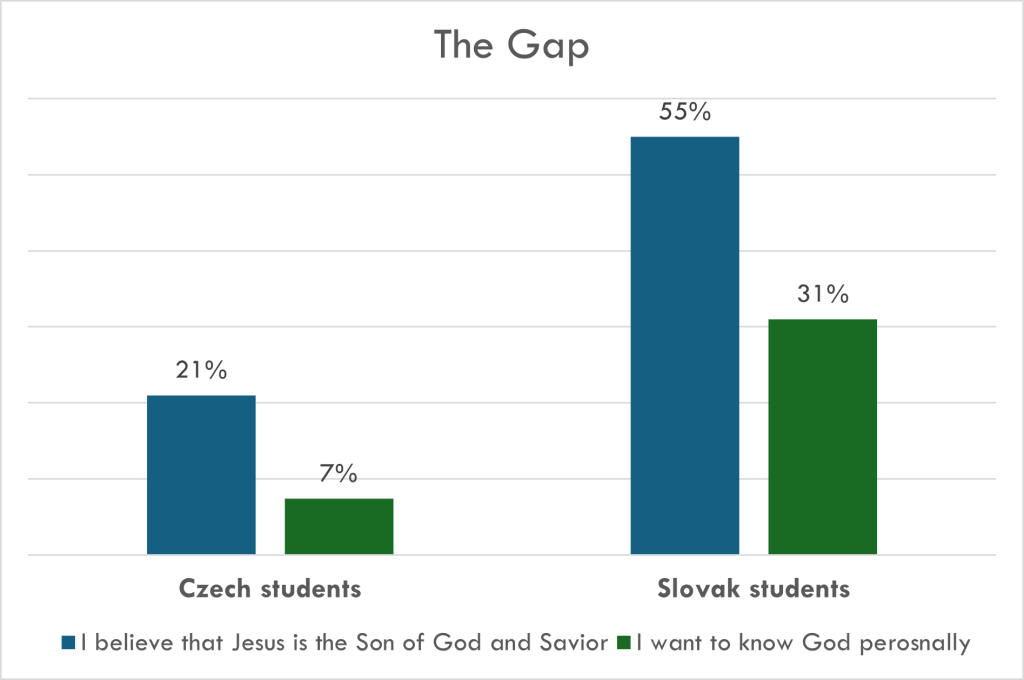
Perhaps the biggest takeaway from this study came from a pair of questions that we used for segmentation. The respondents’ answers to these two questions gave us incredible insights into the underlying spiritual issues of these youth that were surveyed. When asked about Jesus Christ, 21% of Czech students and 55% of Slovak students said they believed Jesus is the Son of God and Savior of the world. We were stunned: these weren’t tiny fringe numbers: this was a substantial portion of the youth population. Yet when we asked them if they were interested in knowing God personally, those numbers collapsed. Only 7.4% of Czech students and 31% of Slovak students who believed in Jesus expressed genuine interest in knowing Him. The issue wasn’t unbelief: it was indifference. Students were experiencing what we came to call a “crisis of concern, not a crisis of belief.”
To understand more about the “why” behind this indifference, we developed what we called a “hunger score”—a metric that measured the gap between what mattered most to students and how fulfilled they felt. The formula was simple: Hunger = Importance × (Importance – Fulfillment), where the importance of an issue and the fulfillment of an issue were measured on a 1 – 7 scale. Perhaps understanding the greatest needs of these students and where they turned to meet them would help us understand why there was so little desire to know God personally.
The Happiness Hunger
When we measured what students hungered for most, one need towered above all others: Happiness. This score consistently showed a gap between the importance and fulfillment of this need across all students surveyed. When we asked students where they looked to find happiness, they turned overwhelmingly to their most personal human relationships—family first (84-94%), then friends (73-79%), and then romantic partners.
And God? In the Czech Republic, only 7.1% looked to God for happiness (unsurprisingly, this matches the number of those who want to know God personally). God ranked dead last—#10 out of 10 options. Even among students who believed in God and were interested in Him, only 58.8% looked to God as a source of happiness.
The research revealed something profound: Students didn’t see God as personal. He didn’t fall into the same category as parents, friends, or lovers. They couldn’t relate to Him the way they related to the people who made them happy. God felt distant, impersonal, institutional—not like someone you’d turn to when you needed joy.
The Hunger for Love
Being loved and accepted was the second major need we measured. Here, the gender differences in particular were striking:
- Female students: hunger score of 4.29
- Male students: hunger score of 1.37
Young women desperately wanted to feel loved and accepted. Young men? They were remarkably indifferent to it. For them, personal freedom and autonomy mattered far more. Again, students looked primarily to family (81-88%), friends (73-80%), and romantic relationships (38-52%) to meet this need. God barely registered as a source of love in the Czech Republic. The pattern continued: students sought personal connection through human relationships, not through the Divine.
Following their Parents: the Church Credibility Crisis
One of the most revealing findings was how closely students’ religious practices mirrored their parents’. The institutional atheism of more than a generation of Marxism appeared to be an inherited trait. In the Czech Republic, 70.6% of mothers and 72.3% of fathers claimed no religious affiliation and most never attended church. In Slovakia, while 70.3% of mothers and 64.9% of fathers identified as Roman Catholic, most attended church only once or twice a year—if at all.
And then we got to the question that explained everything else. When we asked students if the church was a credible institution, the numbers were devastating: in the Czech Republic, only 9% of students said the church was credible, and in Slovakia only 15.3% said the church was credible.
What was the number one criticism? In Slovakia, it was clear: “Churches teach rules they do not obey”—hypocrisy (22.6%). In the Czech Republic, the harshest criticism was that churches “brainwash” believers and limit their freedom (23.2%). These young people hadn’t rejected God. They’d rejected the institution that claimed to represent Him. They saw the church as hypocritical, manipulative, disconnected from real needs, and untrustworthy.
Remember that this same study showed that while 21% of Czech and 55% of Slovak students believe Jesus is the Son of God, when you add the qualifier “and I am interested in knowing Him,” those numbers drop to 7.4% Czech and 31% Slovak. Where is the church that should be there to bridge this gap?
What This Means Today
Where in life are those teenagers we surveyed in 2011? They’re now in their late twenties and early thirties. They’re starting families of their own. And here’s what the most recent data from across Europe tells us: the pattern we documented hasn’t disappeared. If anything, it’s intensifying. Young people describe feeling “spiritually adrift in an age of uncertainty.” They’re searching for stability, hope, and identity. They’re seeking meaning in what researchers call a “liquid world, lacking clear reference points.”
Researchers studying this phenomenon note something critical: “The type of spiritual conversations that people are looking for now are not so much an academic apologetic approach, but rather an apologetic approach to the heart. People want to hear about experiences and are looking for a more emotional dimension.” This is something I explored in greater depth when I did a different research study in France in 2019. People want the beauty and authenticity that flow from a personal relationship. They want to experience God, not just learn about Him. I believe that the explosion of charismatic congregations across Europe attests to this fact.
The Challenge for Christian Ministry
The opportunity is enormous. People across Europe are spiritually open, hungry for meaning, and desperate for authentic connection. They believe—they just don’t know where to find what they’re looking for.
The barrier is institutional credibility. And that credibility won’t be rebuilt through better marketing or hipper worship services. It will be rebuilt through authentic demonstration of faith—not just teaching rules, but living them. This can come through transparency about past and present failures. This can be experienced through meeting people’s felt needs for happiness, love, and meaning. This can happen through presenting God as deeply personal and relational, not distant and institutional. The young people of Europe haven’t rejected God. They’ve just been waiting—sometimes their whole lives—for someone trustworthy to introduce them.
POSTSCRIPT: This is why rigorous research is so crucial. Our assumptions—even the ones we hold most confidently—can be spectacularly wrong. We think we understand the spiritual landscape of Europe. We think we know what’s happening in the hearts of young people. But without asking them directly, without measuring not just what they believe but how intensely they feel their deepest needs, we’re operating on narrative rather than evidence. This study challenged everything we thought we knew. It upended our assumptions and forced us to see Europe not as a secular wasteland, but as a continent full of spiritually hungry young people searching for authentic answers. The numbers didn’t confirm our theories—they contradicted them, and that’s exactly what good research is supposed to do.
 Clarity Research