
How Clarity Research Uses Artificial Intelligence
Clarity Research is cautiously optimistic about the use of AI in marketing research. I have been using AI tools for the last two years and have seen them dramatically amplify my ability to analyze the large volumes of data my projects generate. At the same time, I am acutely aware of the risks of hallucinations (AI providing false information), cognitive offloading (letting AI replace human thinking), and convergent ideation (AI failing to make the creative leaps that human minds can make).
Because of this, AI is used at Clarity to augment — not replace — human expertise. In practice, using AI has actually increased my workload by about 10–15%, but it has increased my output by roughly 50–75%. The result is more thorough, more clearly communicated insights for clients.AI-and-Market-Research.docx
Principles for AI Use
At Clarity Research, I am committed to using AI in a robust, transparent, and limited way. Specifically, AI is used in the following areas:
- Preliminary secondary research for all projects. I use the Claude LLM because it has a lower hallucination rate than many competing models, and its parent company (Anthropic) has taken a particularly open and vigilant stance on issues such as agentic misalignment—when an autonomous or semi‑autonomous AI agent’s behavior, strategies, or goals diverge from what humans intend.
- Analysis support for large qualitative datasets (such as focus groups and depth interviews). However, AI is never used without my first listening to the interviews or fully reading the transcripts myself. At Clarity Research, AI never replaces human learning or direct engagement with the data.
- Drafting support and proofreading for client proposals and reports. All outlines, arguments, insights, and recommendations are generated and controlled by humans; AI may assist with organization, wording, and proofreading.
- Guardrails on synthetic data. Clarity Research will never use synthetic data or synthetic respondents to inflate sample sizes. Some firms now augment human data with AI‑generated “respondents” as a shortcut; I consider this a violation of research integrity and do not employ this practice.
I have written several articles in the last few months on the responsible use of AI. Below are two that discuss how AI must be managed to harness its benefits and the dangers of its over-use in market research.
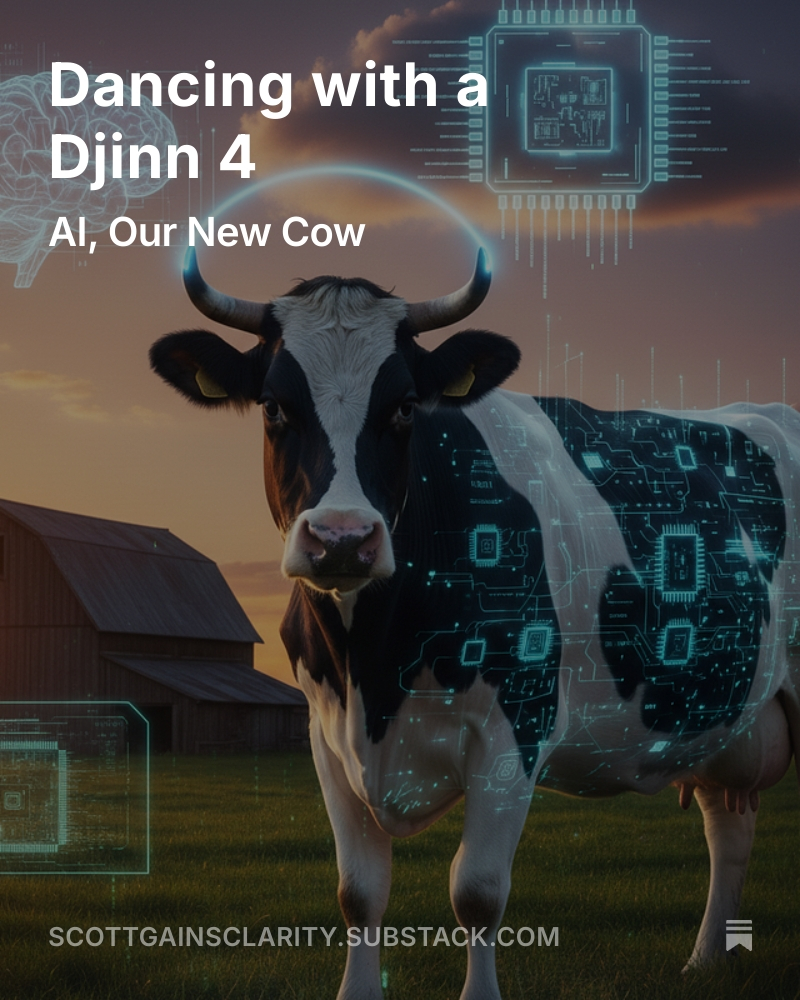
Artificial intelligence isn’t a god or a demon — it’s a beast we must learn to domesticate. Like the first humans who turned wild cattle into partners in civilization, we must harness AI’s power without surrendering our agency of thought. To yield our thinking to it would be a catastrophic reversal — the beast becoming the master.
 Clarity Research